LIII Session of the OSJD Ministerial Conference (press-release)
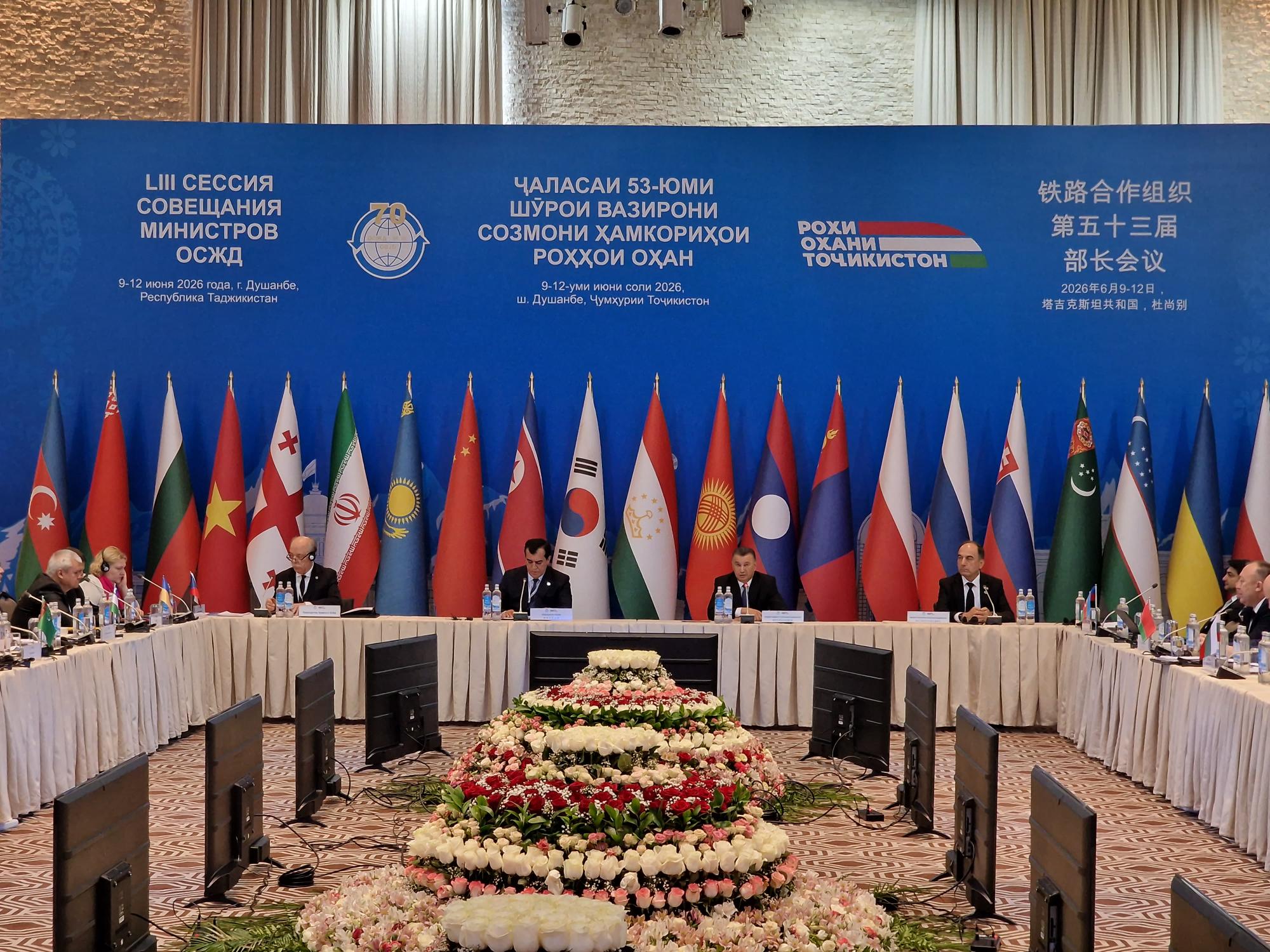
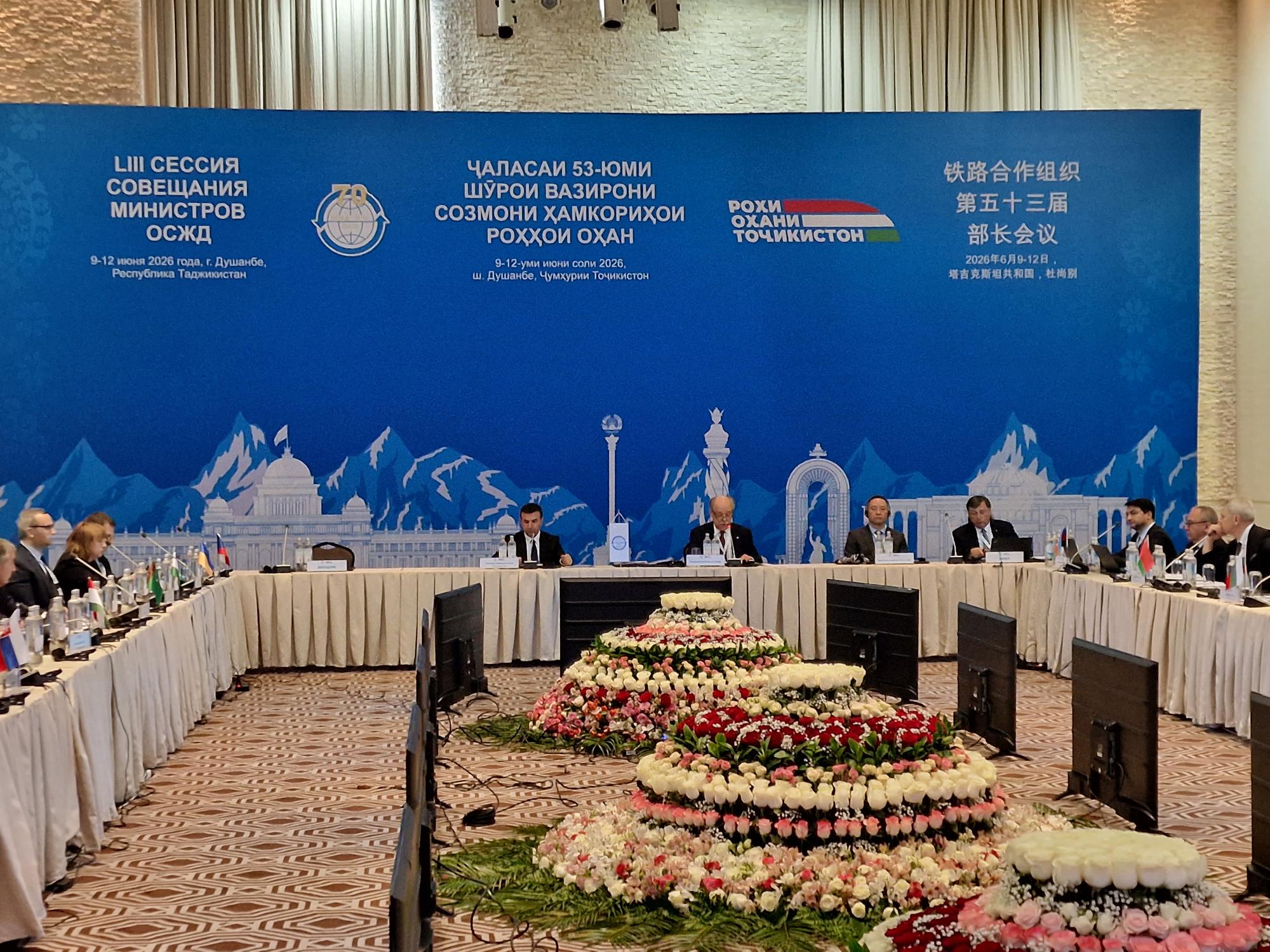
The LIII (53rd) session of the OSJD Ministerial Conference took place from 9 till 12 June 2026 in Dushanbe, the capital of the Republic of Tajikistan. The session was attended by the representatives from the following members of the OSJD Ministerial Conference:
Republic of Azerbaijan, Republic of Belarus, Republic of Bulgaria, Socialist Republic of Vietnam, Georgia, Islamic Republic of Iran, Republic of Kazakhstan, People’s Republic of China, Democratic People’s Republic of Korea, Republic of Korea, Kyrgyz Republic, Lao People’s Democratic Republic, Mongolia, Republic of Poland, Russian Federation, Slovak Republic, Republic of Tajikistan, Turkmenistan, Republic of Uzbekistan, Ukraine, Czech Republic, as well as Secretary General of the TRACECA Intergovernmental Commission and staff members of the OSJD Committee.
The session was chaired by Komil Mirzoali, Head of the State Unitary Enterprise “Rohi Ohani Tojikiston” (Tajik Railway), while the duties of the session secretary were performed by Mirosław Antonowicz, OSJD Committee Chairman.
Noting the 70th anniversary of the OSJD foundation, Prime Minister of the Republic of Tajikistan Kokhir Rasulzoda, Minister of Transport of the Republic of Tajikistan Azim Ibrohim, and Head of the State Unitary Enterprise “Rohi Ohani Tojikiston” (Tajik Railway) Komil Mirzoali delivered welcoming remarks to the participants. They welcomed all the delegations in Dushanbe, the capital of the Republic of Tajikistan, and emphasized the great honour and significance of hosting the 53rd session of the OSJD Ministerial Conference in Tajikistan during the year of the Organisation’s 70th anniversary. They also provided an update on the development of railway transport in the country, noting its leading role in passenger and freight transportation. Furthermore, they underscored the importance of continuing cooperation within the OSJD framework among all member railways, particularly in the conditions of constantly changing global economic and transport-logistics situation.
Prime Minister of the Republic of Tajikistan Kokhir Rasulzoda highlighted that hosting the 53rd session of the OSJD Ministerial Conference in Tajikistan has proved the country’s proactive position within the Organisation and its active engagement in the activities of the international transport community.
For Tajikistan – as for other landlocked nations in the region – railway transport is of strategic importance. In light of the ongoing transformation of global trade routes and shifts in logistics chains, the efficient utilization of transit potential has become especially crucial. Consequently, Tajikistan considers it expedient to continue collaborative efforts towards developing international transport corridors, modernize transport infrastructure, and streamline procedures for the transportation and transit of goods.
The Prime Minister noted that, with the aim of accelerating freight flows and reducing paper-based documentation exchange, a “Strategy for the digitalization of key multimodal transport corridors of the CIS member states”, prepared by the Republic of Tajikistan, was adopted in 2025.
In his remarks, Minister of Transport of the Republic of Tajikistan, Azim Ibrohim, highlighted that railway transport remains one of the most vital strategic sectors of the country’s economy. Since gaining independence, Tajikistan has constructed and commissioned over 220 kilometers of new railway lines of regional and international significance. Approximately 75 percent of Tajikistan’s foreign trade freight flows is transported by rail. In 2025, the volume of goods transported reached 7,508,000 tons, while passenger traffic totaled approximately 456,000 people. As compared to the same period in the previous year, freight volume increased by 12 percent, and passenger traffic grew by 2 percent. To further develop the sector, 13 investment projects have been formulated, covering the construction of new railway lines, the modernization of infrastructure, and the renewal of rolling stock.
Azim Ibrohim has also emphasized the particular importance of the project for the construction of the “Jaloliddini Balkhi – Jayhun – Lower Panj” railway line, which will extend to the border with Afghanistan. Simultaneously, active works are underway to develop the “Tajikistan – Uzbekistan – Turkmenistan – Iran – Türkiye – Europe” transport corridor. This corridor creates new opportunities for organising multimodal transportation and establishing the shortest possible transit route between China and the European nations.
The Minister of Transport further noted that, alongside infrastructure development, the Republic of Tajikistan is placing a strong focus on the digitalization of the transport sector. A Center for the Digitalization of the Transport Sector is currently operated under the Ministry of Transport; its mandate includes implementing modern digital technologies and electronic permitting systems, automating management processes, as well as monitoring freight flows and establishing a unified digital platform for transport services. Other priority tasks include:
– the electrification of the “Bekobod – Istiklol”, “Pakhtaobod – Vahdat”, and “Khoshadi – Kulab” railway sections;
– the renewal of the rolling stock fleet: locomotives, passenger coaches and freight wagons;
– the modernization of power supply, communications, and signaling systems;
– the rehabilitation of railway infrastructure.
Komil Mirzoali, Head of the State Unitary Enterprise “Rohi Ohani Tojikiston” (Tajik Railway), stated in his remarks that multilateral cooperation within the framework of the OSJD serves as a unique instrument for fostering a unified transport and economic space. Thanks to the support of the Government of the Republic of Tajikistan – and, above all, President Emomali Rahmon – the railway sector has been able to concentrate its efforts on the development process. Key priorities have included modernizing infrastructure, constructing new railway sections, and increasing freight and passenger traffic volumes.
Since the Republic of Tajikistan gained its independence, significant infrastructure projects of strategic importance for the development of the national railway network have been implemented. In 1999, the “Qurghonteppa – Kulab” railway section was put into operation, marking the first railway line constructed during the country’s independence. In 2016, the construction of the “Vahdat – Yovon” section was completed, connecting the central and southern parts of the Republic’s railway network and facilitating the creation of a unified national railway space.
According to Komil Mirzoali, the priority areas for the Tajik Railway include infrastructure modernization, digitalization of transport processes, electrification of railway lines, renewal of rolling stock, and the development of international freight routes. Currently, the Tajik Railway, in cooperation with the Korea International Cooperation Agency (KOICA), is preparing a feasibility study for the construction of a railway line from Jaloliddini Balkhi to Lower Panj. The implementation of this project will contribute to the further development of the country’s transport infrastructure, strengthen regional connectivity, and expand Tajikistan’s international transport and logistics capabilities.
Mirosław Antonowicz, OSJD Committee Chairman, welcomed all delegations that arrived in Dushanbe for the meeting, organised in an intramural mode. He wished the participants a productive and constructive discussions and provided a brief overview of the OSJD’s current activities, as well as the development of international railway transport within the OSJD region.
During the discussion, the heads of the delegations expressed their sincere appreciation for the high standard of organisation provided by the Tajik party. They also underscored the importance of continuing and expanding cooperation within the OSJD framework for the benefit of railway transport and economic development of all OSJD member states.
The session agenda included the consideration and approval as follows:
- Report on OSJD Activities for 2025;
- Report of the OSJD Auditing Commission for 2025;
- progress of work carried out in 2025 by the OSJD Commissions on Transport Policy and Development Strategy and on Transport Law;
- progress of work of the Ad Hoc Working Group (AWG) on professional training/education in the field of railway transport for the period from March 2025 till March 2026;
- OSJD Work Programme for 2027 and subsequent years;
- OSJD Committee Budget (the final budget for 2026 and the preliminary budget for 2027);
- seat (location) of the OSJD Committee;
- composition and rotation procedure for members of the OSJD Auditing Commission;
- draft preliminary agenda, venue, and date for the 54th (LIV) session of the OSJD Ministerial Conference.
The OSJD Ministerial Conference noted the implementation of the OSJD Work Programme and Plan for 2025 and approved the Report on OSJD Activities for 2025, as well as the Report of the OSJD Auditing Commission for 2025.
In the field of transport policy and development strategy, the session approved the work progress of the OSJD Commission on Transport Policy and Development Strategy for 2025 and instructed to continue the works on:
- updating the “Comprehensive Plans for the improvement of transport operations and development of OSJD railway transport corridors Nos. 1–13 until 2030”;
- monitoring the implementation of the “Comprehensive Plans for the improvement of transport operations and development of OSJD railway transport corridors Nos. 1–13 until 2030”;
- updating the Technical and Operational Passports for OSJD railway transport corridors Nos. 1–13;
- implementing the provisions of the Memoranda of Cooperation on the technical, operational, and commercial development of the OSJD railway transport corridors;
- updating OSJD Leaflet R 305-1 “OSJD Glossary”;
- improving OSJD railway transport statistical reports, with a focus on ensuring data submission in the prescribed format;
- developing measures to facilitate border crossing procedures for international railway traffic within the Eurasian region;
- refining the Agreement on organisational and operational aspects of combined transport between Europe and Asia, and updating Annexes I, II, III, and IV to the Agreement, with the participation of concerned OSJD member states;
- addressing environmental and ecological issues within the railway transport sector.
The information regarding the works carried out and the additional tools developed during the consultative meetings of the member states of OSJD railway transport corridor No. 1 over the reporting period was duly noted.
The members of the OSJD Ministerial Conference from the Republic of Belarus, Republic of Kazakhstan, People’s Republic of China, Democratic People’s Republic of Korea, Mongolia, and Russian Federation proposed to transform the consultative meetings on the development of OSJD railway transport corridor No. 1 into a Working Group (coordinating body) for the management of the above mentioned corridor. They further recommended extending these approaches and the documentation developed for establishing such coordinating bodies to all OSJD railway transport corridors (in accordance with Clause 6 of the Memorandum of Cooperation on the technical, operational, and commercial development of OSJD railway corridors).
The member of the OSJD Ministerial Conference representing the Republic of Poland emphasized his interest in developing freight transport along the China–Central Asia–Europe corridor, while stating that a return to full-scale operations under OSJD Railway Transport Corridor No. 1 would only be possible once the situation across the Eurasian region has normalized.
The OSJD Ministerial Conference session deemed it appropriate to consider the possibility of increasing the number of the meetings focused on ecology and the environmental protection within the railway transport sector. It was proposed that this matter be addressed at the final meeting of the OSJD Commission on Transport Policy and Development Strategy; subsequently, depending on the decision reached, the proposal is to be submitted for consideration to the Joint meeting of the Plenipotentiary Representatives of the Members of OSJD Ministerial Conference and the Conference of General Directors (Authorized Representatives) of OSJD Railways.
In the field of the transport law, the OSJD Ministerial Conference session approved the activities carried out by the OSJD Commission on Transport Law in 2025 and instructed that efforts be continued in the following areas:
- improving the Agreement on International Passenger Traffic (SMPS) and its Service Instruction, as well as the Agreement on International Railway Freight Traffic (SMGS) and Service Instruction thereto;
- refining Annex 6 to the SMGS – “CIM/SMGS Consignment Note Manual” as part of the “CIM/SMGS Transport Law Harmonization” project;
- developing a document of title for the goods (within the framework of the Ad Hoc Working Group on the Documents of Title);
- updating Annex 2 to the SMGS – “Rules for the Transportation of Dangerous Goods” (within the framework of the Ad Hoc Working Group on the Rules for the Transportation of Dangerous Goods);
- establishing technical specifications for stowing and securing of goods in 1520-mm gauge railway wagons (within the framework of the Ad Hoc Working Group on the Development of Technical Specifications for stowing and securing of goods).
The Meeting also took note of the upcoming entry into force of amendments and additions to the SMPS Agreement and its Service Instruction, effective as of 1 May 2026, as well as amendments and additions to the SMGS Agreement, effective as of 1 July 2026.
The members of the OSJD Ministerial Conference from the Republic of Azerbaijan, Republic of Bulgaria, Georgia, Republic of Kazakhstan, People’s Republic of China, Kyrgyz Republic, Slovak Republic, Turkmenistan, and Ukraine expressed their gratitude to the participants of the Ad Hoc Working Group (AWG) on railway and waterway transport and the OSJD Commission on Transport Law for their work. They further drew the attention of the Ministerial Conference to the need to expedite the adoption of comprehensive amendments and additions to the SMGS Agreement, with the objective of enabling the use of the SMGS consignment note for the waterborne segments of transport routes by the time of the next session of the Ministerial Conference.
The session approved the progress report of the Ad Hoc Working Group on professional education/training in the field of railway transport for the period from March 2025 till March 2026, and endorsed the AWG’s efforts to develop content for the OSJD Web-portal dedicated to the professional training and education.
The AWG has been tasked to continue its works on:
- updating the OSJD Web-portal in order to promote professional training and education for personnel in the field of railway transport sector;
- developing recommended lists of standard OSJD training programmes, as well as drafting model training programmes – intended for guidance – focused on professional development and the application of transport-related regulatory and legal documents;
- updating the terminology related to the training and education of railway transport personnel;
- implementing pilot training projects, with the participation of concerned organisations;
- organising conferences, seminars, workshops and roundtables on personnel training and education, including such events held in conjunction with the meetings of the OSJD governing bodies;
- facilitating the exchange of best practices in the field of training and education.
The OSJD Ministerial Conference tasked the Ad Hoc Working Group to prepare draft documents for subsequent consideration and approval by the OSJD governing bodies in accordance with established procedures, specifically regarding:
- the transformation of the AWG into a Permanent Working Group on professional education/training in the field of railway transport – addressing its composition, functions, and financing, as well as the relationship and interaction between the OSJD Committee and the future OSJD Academy;
- the introduction of comprehensive amendments to previously adopted OSJD documents concerning the functioning of the OSJD Academy.
The OSJD working bodies and the OSJD Committee have been instructed to continue their activities in line with the approved Work Programme and Plans.
In pursuance of Article II, Paragraph 2 of the OSJD Regulations, the Ministerial Conference deemed it appropriate to develop an “OSJD Development Strategy”; consequently, the OSJD Committee has been tasked with preparing a concept and a draft structure for this strategy.
The concept and draft structure of the “OSJD Development Strategy” are to be subject to preliminary review by a Joint meeting of the Plenipotentiary Representatives of Members of the Ministerial Conference and Members of the Conference of General Directors.
In accordance with Article X of the OSJD Regulations, the Ministerial Conference has designated Warsaw, the capital of the Republic of Poland, as the seat of the OSJD Committee.
The LIII session of the OSJD Ministerial Conference has decided to hold its next LIV (54th) session in June 2027.
The decisions adopted during the LIII session of the OSJD Ministerial Conference are aimed at fulfilling the tasks facing the Organisation, further developing railway transport in all member countries, enhancing its efficiency and competitiveness, and strengthening cooperation and mutual trust among all railway administrations for the sake of the economic prosperity of all member states.